
The Socio-Economic Impact of the Cashew Industry: Living Income, Poverty Alleviation and Community Resilience
Cashew is one of the most economically significant tree crops in the world, providing income for millions of smallholder farming households across Africa, Asia, and Latin America.
The sector's social and economic performance — how fairly it distributes value, how effectively it reduces poverty, and how resilient the communities it supports are — is increasingly subject to rigorous measurement and reporting.
This page provides an evidence-led overview of the frameworks and research shaping that work, and links out to detailed modules on measuring cashew's impact on rural livelihoods, EU-funded living wage and living income studies, socio-economic research and case studies, community resilience indicators, academic and institutional partnerships, and economic justice in cashew production.
Cashew's Socio-Economic Impact: Living Income, Poverty, and Resilience at a Glance
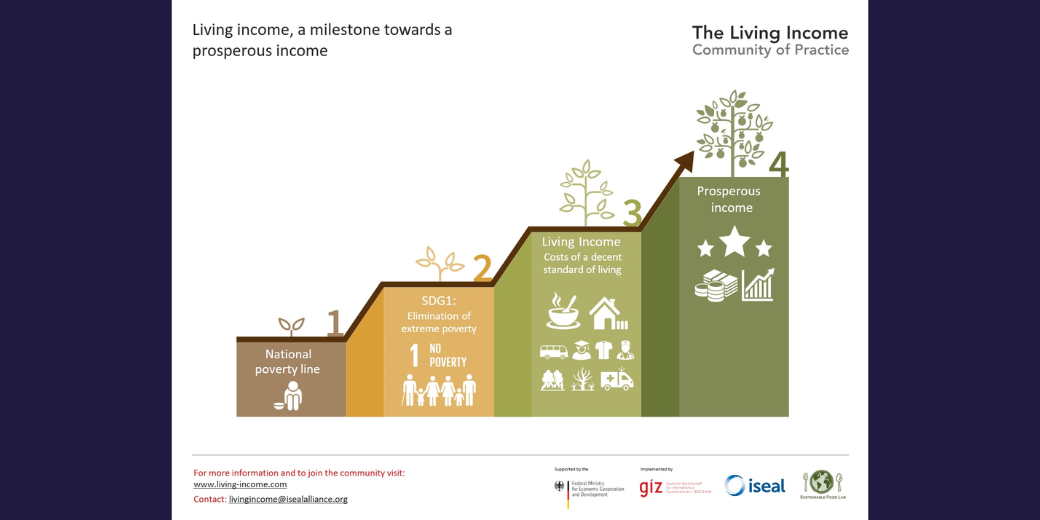
- Living income methods: The Anker Methodology and Living Income Community of Practice frameworks provide the evidential foundation for measuring whether cashew producers earn enough to meet basic needs.
- Primary income: In many producing regions cashew is the main source of household cash income, making the performance of the cashew season hugely consequential for family welfare.
- True cost accounting: Approaches such as True Price quantify social and environmental externalities — carbon emissions, child-labour risk and soil degradation — that standard financial reporting excludes.
- Resilience metrics: FAO frameworks extend impact measurement beyond income to assess community capacity to absorb price volatility, climate shocks and market disruption.
- Collaborative metrics: Credible social indicators depend on academic and multi-stakeholder collaboration, with organisations such as the Sustainable Food Lab shaping equity-focused indicator development.
Jump to: Methodologies for Impact Assessment · Poverty Alleviation & Income Diversification · Quantifying Externalities · Resilience Frameworks · Impact Reporting & Progress Tracking · Collaborative Research & Inclusive Growth · Interconnected Themes · Next Steps
Methodologies for Socio-Economic Impact Assessment
Credible social impact measurement starts with agreed methodologies for defining what counts as adequate income, how it's measured, and how gaps are identified.
- The Living Income Community of Practice brings together practitioners, researchers and companies to build shared approaches to measuring and closing the living income gap in agricultural supply chains
- Its tools cover reference price calculation, gap analysis and company action frameworks applicable to smallholder cashew systems
- The Global Living Wage Coalition provides complementary standards for wage benchmarking in employment contexts, establishing regionally specific reference points against which labour conditions in cashew processing and export can be evaluated
The module on EU-funded living wage and living income studies examines how these methodologies have been applied to cashew value chains across producing regions.
Poverty Alleviation and Rural Income Diversification
In many of the world's major cashew-producing regions cashew is often the primary source of household cash income.
For smallholder farmers with limited access to alternative markets, the performance of the cashew season — in terms of prices paid, volumes sold and payment timing — can be the difference between meeting basic needs and falling into debt.
The African Cashew Alliance — a sector body founded in 2006 representing companies across the African cashew industry — provides market-level data on volumes, pricing and trade flows that forms part of the baseline for tracking sector-wide social progress.
Our module on measuring cashew's impact on rural livelihoods examines how cashew income flows to farming households and where value chain inefficiencies reduce the share reaching producers.
Living Wage Benchmarks
Establishing what constitutes a living wage in cashew-producing regions requires location-specific research into the cost of basic needs.
The Anker Methodology provides a standardised approach to calculating the income needed for a family of a defined size to afford:
- Food
- Housing
- Healthcare
- Education
- A small discretionary margin
Applying this to cashew-producing communities requires local data collection and regular updating as costs change.
The module on EU-funded living wage and living income studies covers specific benchmarking work carried out in cashew-producing regions.
Quantifying Social and Environmental Externalities
Standard financial accounting doesn't capture the full costs and benefits that cashew production generates for communities and ecosystems.
True Cost Accounting (TCA) methods make these externalities visible, assigning values to outcomes otherwise excluded from commercial decision-making, such as:
- Soil degradation
- Carbon emissions
- Child labour risk
- Community health
True Price has developed methodologies for calculating the 'true price' of agricultural products by incorporating these social and environmental costs alongside conventional financial analysis.
The Impact Institute offers complementary frameworks for impact valuation at organisation and value chain level, including tools applicable to food and agricultural systems.
The modules on EU-funded living wage and living income studies and the socio-economics research unit examine how these approaches have been applied within the cashew sector.
Frameworks for Measuring Community Resilience
The capacity of cashew-dependent communities to withstand shocks — whether from price volatility, climate events or health crises — is a key indicator of how well the sector is working for the people at its core.
Resilience measurement goes beyond income levels to assess access to services, social networks, savings behaviour and adaptive capacity.
FAO's socio-economic analysis and policy work provides frameworks for assessing rural household resilience across agricultural contexts, drawing on multi-country datasets and longitudinal fieldwork relevant to smallholder tree crop systems.
The module on community resilience and inclusive growth indicators examines how these frameworks apply to cashew-producing communities and what the evidence shows about resilience across producing regions.
Long-Term Impact Reporting and Progress Tracking
Tracking progress against social and economic goals in cashew supply chains requires consistent reporting standards applied over time.
Both the Impact Institute and the African Cashew Alliance produce research and reporting that document social outcomes at value chain and sector level, providing a basis for comparison and accountability.
The module on the socio-economics research unit covers the specific studies, datasets and reporting frameworks in use across the sector, and the module on partnerships explores the academic and institutional relationships driving this work.
Collaborative Research and Inclusive Growth Indicators
The development of credible social metrics for cashew supply chains depends on collaboration between sector practitioners, research institutions and development organisations.
Such partnerships contribute academic rigour to impact measurement and the design of inclusive growth indicators.
The Sustainable Food Lab also works at the intersection of food system change and inclusive business models, bringing multi-stakeholder approaches to the development of equity-focused performance indicators.
This theme connects directly to Section 2: Sustainability and Regenerative Practices, where environmental and social measurement frameworks increasingly overlap in ESG reporting.
The module on partnerships examines these relationships and their contribution to the sector's evidence base, and the module on economic justice and fair trade in cashew production covers the structural conditions that shape whether inclusive growth is achievable in practice.
Interconnected Themes in the Cashew Sector
The social and economic dimensions of cashew production don't sit in isolation.
Traceability systems that verify origin and handling data also carry information about producer organisations and pricing structures. Environmental practices shape the long-term productivity and income security of farming communities. And digital tools increasingly underpin social impact measurement alongside agronomic monitoring.
Section 1: Supply Chain Transparency and Traceability examines how supply chain data connects to producer-level evidence.
Section 2: Sustainability and Regenerative Practices explores the environmental conditions that affect smallholder livelihoods.
Section 3: Industry Innovation and Data Science covers the digital infrastructure that supports impact measurement.
And Section 5: Women's Empowerment and Transversal ESG Frameworks addresses the gender dimensions of socio-economic performance in cashew supply chains.
Next Steps and Contact
To examine the themes introduced here in more depth, move through Sections 4.1–4.6 in sequence, beginning with 4.1: Measuring Cashew's Impact on Rural Livelihoods.
Other parts of the Cashew Industry Guide build on the same socio-economic foundations to address traceability, environmental and governance topics.
For enquiries about contributing data or case studies about the socio-economic impact of the cashew industry, or to request expert comment, please get in touch.
Evidence and methodology: You can learn about our source vetting standards, data attribution policy, editorial independence and amendment policy here.