
Why Resilience Matters in Cashew Supply Chains
Cashew supply chains are structurally exposed to disruption. A kernel may move through several countries between harvest and retail shelf, passing through multiple handover points, crossing several regulatory jurisdictions, and depending on certification systems that require continuous maintenance. Each of these characteristics creates a point of vulnerability.
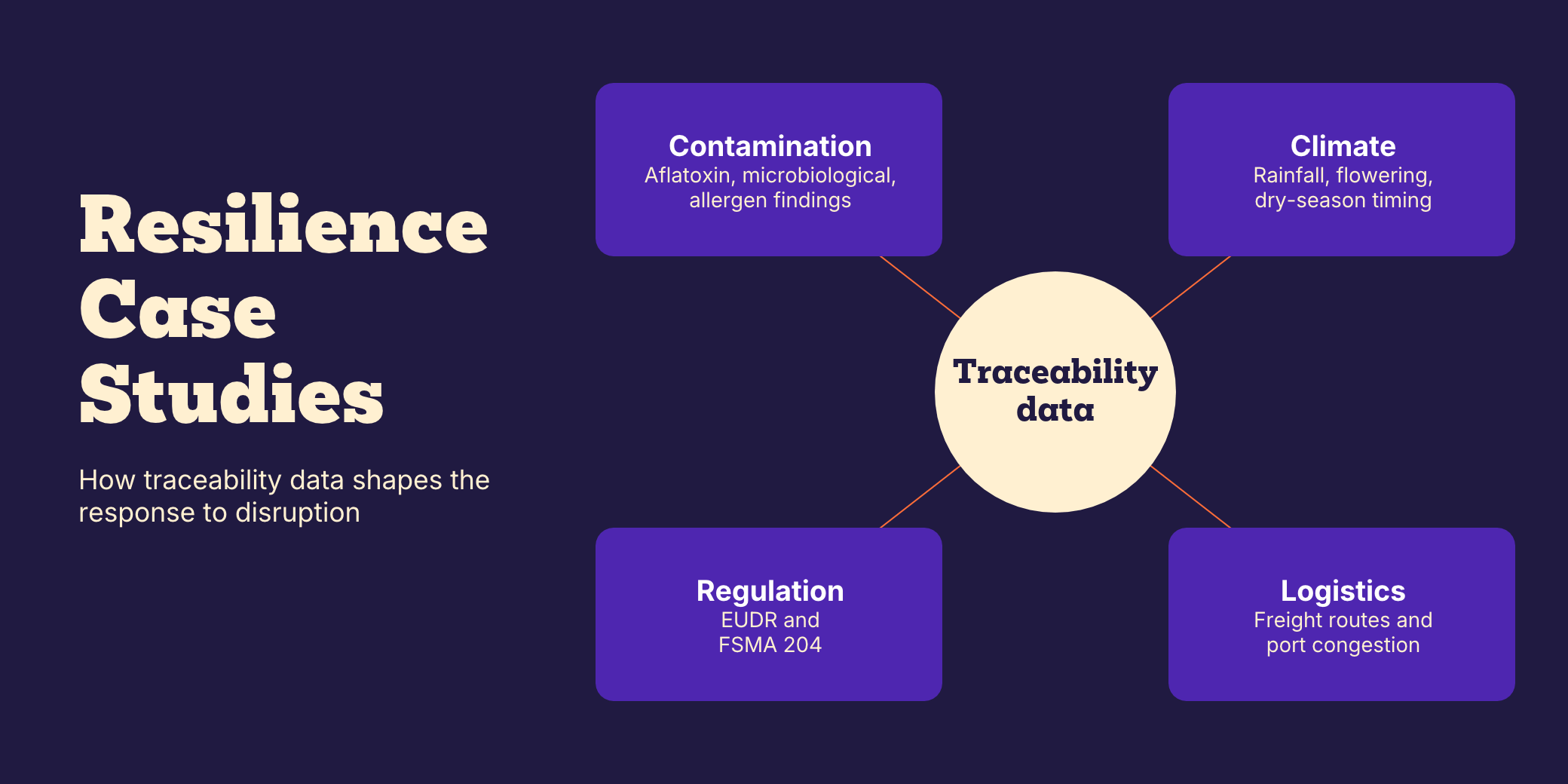
The disruptions that affect cashew supply chains tend to fall into four broad categories:
1. Contamination incidents: Aflatoxin exceedances, microbiological findings, or allergen failures can trigger market withdrawals or border rejections with little warning, and the speed of response depends heavily on how quickly a lot can be traced.
2. Climate-driven harvest disruption: This affects origin-level supply in ways that are increasingly observable in advance, but only if producer-level data exists to monitor them.
3. Regulatory shifts: New traceability mandates, deforestation due diligence requirements and food safety modernisation rules create compliance obligations that prepared suppliers can meet and unprepared ones can’t.
4. Logistical disruption: Container shortages, port congestion and freight route failures have affected cashew supply chains with greater frequency than any of the above, given the crop's dependence on long export routes connecting West African and Asian origins to European and North American end markets.
What the cases in this module show is that the difference between a contained incident and a costly one, or between a compliant supplier and a non-compliant one, is usually determined by decisions made well before the disruption occurred.
The traceability infrastructure described in modules 1.2 and 1.3 of the Supply Chain Transparency and Traceability section of this industry guide doesn't prevent disruption; rather it determines how well an operation can respond to it.
Case 1: Contamination Response and Recall Acceleration
The Scenario
Aflatoxins have historically been one of the most common reasons for RASFF notifications and border rejections involving cashew products entering the EU. The EU's RASFF database records border rejections and market withdrawals for food safety incidents, and cashew shipments appear in that record with some regularity. EU maximum levels for aflatoxins in cashew vary depending on intended use and processing stage. Operators should refer directly to the current limits set out in Regulation (EU) 2023/915 rather than applying a single figure across all contexts.
When a contamination finding occurs - whether at border inspection, during a buyer's incoming quality check, or via a retail customer complaint - the immediate operational question is scope: which lots are affected, where are they, and what has already left the facility or entered retail channels?
How Traceability Data Narrows the Response
In operations with complete lot-level records, the answer to the scope question can typically be established within hours. Effective recall management requires both backward traceability (identifying which farms, cooperatives or input lots contributed to the affected batch) and forward traceability (identifying where the affected material has gone, which customers received it, and whether any has already reached retail channels).
Backward and forward traceability in a cashew recall. Backward traceability identifies which farms, cooperatives or input lots contributed to an affected batch. Forward traceability identifies where the affected material has gone and which customers received it.
A lot identifier linked to a harvest season, a producer or cooperative, a processing batch, and a dispatch record supports both directions of inquiry simultaneously, allowing the affected material to be isolated and the unaffected material to be cleared without precautionary withdrawal of product that isn't implicated.
In operations relying on paper records or fragmented digital systems, the same questions can take days or weeks to answer in either direction. During that period, the precautionary recall scope tends to expand, the cost of the incident rises, and buyer confidence erodes. EFSA and RASFF incident data consistently show that the duration and scope of food safety incidents in commodity supply chains correlates with the completeness of the traceability record available at the time the incident is identified.
What Makes the Difference
The operations that respond most effectively to contamination incidents share three characteristics:
- Lot identifiers that are consistent from origin through to dispatch
- Records that are retrievable on demand, rather than requiring manual reconstruction
- A defined response protocol that assigns responsibility for trace-back and stakeholder notification before an incident occurs
The last point matters more than it might appear. A team that has rehearsed the response process handles an actual incident significantly faster than one encountering it for the first time under pressure.
Case 2: Regulatory Shift - EUDR, FSMA 204, and Traceability-Ready Supply Chains
The Scenario
Two regulatory developments are currently reshaping traceability expectations for food supply chains serving European and US markets, and both have implications for cashew operators, even where cashew is not yet explicitly named in scope.
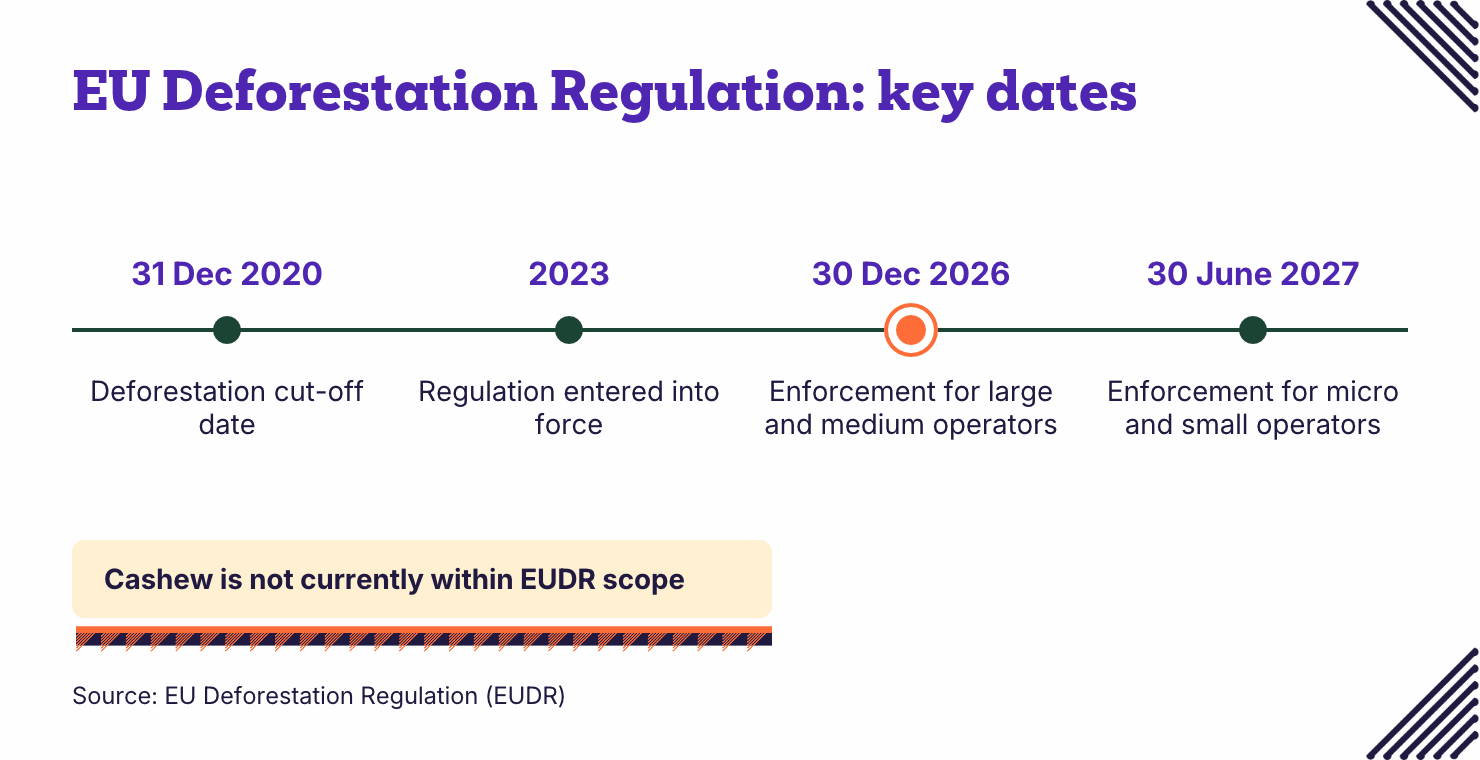
The EU Deforestation Regulation (EUDR), which entered into force in 2023, requires that certain commodities and derived products placed on the EU market must not have contributed to deforestation or forest degradation after 31 December 2020. The regulation currently covers cattle, cocoa, coffee, oil palm, rubber, soy and wood. Cashew isn't presently within scope, but the EUDR establishes a due diligence architecture requiring operators to provide GPS coordinates of production plots, evidence of legal land use and documented supply chain records that many observers believe could influence future regulatory developments beyond the commodities currently in scope. Enforcement applies to large and medium operators from 30 December 2026 and to micro and small operators from 30 June 2027.
Suppliers already operating traceability systems capable of capturing plot-level origin data are well positioned to respond to any scope expansion without structural investment, while those building from paper records face a more significant transition.
FDA FSMA Section 204, the Food Traceability Rule, requires US food companies to maintain enhanced traceability records for foods on the Food Traceability List (FTL). Cashew kernels as whole tree nuts are generally not within scope of the FTL; operators should verify the current list directly with the FDA, as scope can be updated. Certain nut butters and processed nut products may fall within scope depending on their formulation and processing.
Where FSMA 204 does apply, the rule requires Key Data Elements (KDEs) to be captured at each Critical Tracking Event (CTE) in the supply chain, effectively a codified version of the lot identifier and handover data field discipline described in module 1.2.
For cashew processors targeting the US market, understanding which of their product formats fall within FTL scope is a practical compliance step regardless of whether whole kernels are currently listed, given the direction of travel in US food traceability regulation.
Compliance deadlines have been subject to revision, and operators should verify current requirements directly with the FDA, but the direction of travel is clear: regulators in both the EU and US are moving toward mandatory, documented, auditable traceability as a condition of market access rather than a voluntary quality measure.
What ‘Traceability-Ready’ Looks Like in Practice
The distinction between prepared and unprepared suppliers is not primarily about technology. It's about whether the underlying protocol - consistent lot identifiers, agreed data fields at each handover, assigned audit-trail responsibility - is already operational.
A supplier with that discipline in place can adapt to new reporting requirements by adjusting what data is captured and how it's formatted, without rebuilding the system from scratch. A supplier without it faces the harder task of implementing a traceability protocol under deadline pressure while simultaneously managing commercial operations.
The practical implication for buyers is that a supplier's current traceability practice is a good indicator of their regulatory readiness. A supplier who can demonstrate lot-level trace-back on request today is likely to be capable of meeting enhanced documentation requirements when they become mandatory. On the other hand, one who can’t is a compliance risk that regulatory change will eventually surface.
The Lesson
Regulatory shifts reward preparation and penalise deferred investment. The EUDR and FSMA 204 both had extended lead times between publication and enforcement, and suppliers who used that lead time to build traceability capability entered the compliance window in a substantially better position than those who waited for confirmed enforcement before acting.
Case 3: Climate-Driven Harvest Disruption and Early Mitigation
The Scenario
Cashew production is concentrated in a small number of origin countries. Côte d'Ivoire dominates global raw cashew nut production while Vietnam dominates the processing and export of cashew kernels, sourcing significant volumes of raw material from West Africa for processing and re-export to European and North American markets. India is both a significant producer and a major processor.
Readers unfamiliar with the industry sometimes conflate production origin with processing origin, a distinction that matters considerably for traceability, since the country named on a kernel export certificate is often the processing country rather than the country where the cashew was grown.
Yields in raw cashew nut producing countries are sensitive to rainfall patterns, temperature during flowering and the timing of the dry season. Climate variability has made these conditions less predictable over recent seasons, with documented production shortfalls and regional production shifts creating supply gaps that have affected pricing and availability at a global level.
For buyers and processors, the problem with climate-driven harvest disruption is not that it's unforeseeable - seasonal forecasting and agrometeorological data provide reasonably early signals - but that the information doesn't reach procurement teams in time to act on it. By the time a shortfall is visible in export volumes or spot prices, the window for mitigation has usually closed.
How Producer-Level Data Supports Earlier Mitigation
Operations with farm or cooperative-level data on crop condition, flowering density and early-harvest yields can identify a developing supply gap significantly earlier than those relying on national production estimates or trade flow data. This earlier signal allows procurement teams to initiate alternative sourcing conversations, adjust customer commitments or build strategic inventory before the market has fully priced the shortage.
Early warning capability isn't solely dependent on farm-level reporting. Remote sensing and satellite observations - including vegetation index data from platforms such as Sentinel-2 - can detect anomalies in cashew orchard condition across producing regions before they're visible in harvest figures. Weather station networks and agrometeorological forecasting services provide additional lead time on rainfall deficits and temperature anomalies during the critical flowering period. Where these data sources are integrated with farm-level records, the resulting picture is considerably more reliable than either source alone.
Cashew Coast runs a crop forecasting programme that combines meteorological data, field agronomic observations, drone imagery and satellite data. The programme produces forecasts about three months before harvest, and indicative forecasts at six months with lower certainty. Processors can build this kind of forecasting in-house or obtain it from third-party agrometeorological services. In both cases, the aim is to give procurement teams an earlier signal of a likely change in supply.
Supply chains that maintain producer-level data connections - through cooperative management systems, farm registration programmes, or origin-side digital tools - are much better positioned to anticipate harvest disruption than those that first encounter supply challenges when a shipment fails to arrive. This means that the investment in origin-side data capture, covered in module 1.2, pays dividends in commercial continuity as well as traceability compliance.
The Lesson
Climate risk in cashew supply chains is increasingly a data problem as much as an agronomic one. The information to anticipate disruption often exists at origin level before it becomes visible in trade flows, but it only reaches buyers if the supply chain has the infrastructure to carry it. Building that infrastructure is a vital traceability project with resilience as one of its outcomes.
Case 4: Operational Disruption: Freight, Labour and Energy
The three scenarios above address contamination, regulation and climate. But operational disruptions - freight route failures, labour shortages, energy outages - have affected cashew supply chains more frequently than any of these, and their impact on traceability and resilience is just as instructive.
The Scenario
From late 2023, Houthi attacks on commercial shipping in the Red Sea forced a significant proportion of container freight to reroute around the Cape of Good Hope, adding transit time, cost and uncertainty to supply chains connecting Asian processing hubs to European markets. For cashew specifically, this disrupted the principal freight route used by Vietnamese and Indian processors supplying European buyers, increasing freight costs sharply and extending lead times at a point when kernel prices were already at historic lows.
The COVID-19 pandemic created a different but related disruption in 2020, when Asian processing capacity operated under restrictions and freight backlogs accumulated on key trade routes. European retailers and importers, accustomed to sourcing predominantly from Asian processors, were prompted to look more actively at African suppliers as an alternative source of certified supply.
Labour shortages during peak processing season and energy supply disruptions are recurring operational risks in cashew-producing regions, particularly where processing infrastructure is expanding faster than supporting utilities.
How Traceability and Certification Data Supports Response
Operational disruptions test supply chain resilience in a different way from contamination or regulatory events. The question is not primarily about trace-back but about substitutability: can a buyer quickly qualify an alternative supplier, and can that supplier demonstrate the certifications and documentation required to enter the supply relationship without delay?
Buyers concentrated on a single processing origin found themselves with limited options when the Red Sea disruption made freight significantly more expensive or unreliable. However, those with established relationships across multiple certified origins had more room to manoeuvre. And for African processors with food safety certifications already in place, the COVID disruption represented a genuine commercial opportunity created by disruption elsewhere in the system.
Cashew Coast holds BRCGS and organic certification. European buyers commonly require GFSI-recognised food safety certification, such as BRCGS, before they approve a new supplier. During the COVID disruption, processors that already held this certification could be considered as alternative suppliers without first completing a certification audit, which shortened the time buyers needed to qualify them.
For labour and energy disruptions specifically, facilities that maintain granular operational records - shift data, production line records, operator accountability - are better placed to manage interruptions without losing lot-level integrity. When a processing line halts mid-batch and restarts under a different shift, a system with operator-level records can maintain the parent-child lot relationship through the interruption; one relying on batch-level paper records often cannot.
Lesson
Operational disruptions reward preparation of a different kind from contamination or regulatory readiness. Supplier diversification across certified origins, maintained as a deliberate procurement policy rather than assembled in response to a crisis, is the primary mitigation. And for suppliers, holding current certifications that meet the requirements of multiple buyer markets is what converts a period of general disruption into a specific commercial opportunity, as the COVID period demonstrated for prepared African processors.
Common Patterns Across the Scenarios
Looking across the contamination, regulatory, climate and operational disruption scenarios, several consistent factors tend to distinguish operations that respond effectively from those that don't.
| Scenario | Disruption | What made the difference |
|---|---|---|
| 1. Contamination | Aflatoxin, microbiological or allergen findings | Consistent lot identifiers from origin to dispatch; records retrievable on demand; a defined response protocol |
| 2. Regulatory shift | EUDR and FSMA 204 | A protocol already in operation: consistent lot identifiers, agreed data fields at each handover, assigned audit-trail responsibility |
| 3. Climate | Rainfall, temperature during flowering, dry-season timing | Producer-level data connections; remote sensing and agrometeorological data integrated with farm records |
| 4. Operational | Red Sea freight rerouting; COVID-19 restrictions; labour shortages and energy disruptions | Supplier diversification across certified origins; certifications that meet several buyer markets; operator-level records |
Source: Cashew Coast Industry Guide, module 1.4; EU RASFF; EUDR; FDA FSMA Section 204.
Pre-Existing Data Discipline
In each scenario, the operations best positioned to respond were those that had built traceability infrastructure as a routine operational practice rather than as a compliance response to a specific requirement. The lot identifiers, handover records and audit trails that enabled a fast contamination response were the same systems that supported regulatory readiness and early harvest signal detection.
Cross-Functional Ownership
Traceability in each scenario required coordination between functions that don't always share data or decision-making authority: quality and operations in the contamination scenario, commercial and compliance in the regulatory scenario, procurement and origin management in the climate scenario, and commercial and supplier management in the operational disruption scenario.
Tested Response Protocols
Across all four disruption types, organisations that have documented and rehearsed response processes handle incidents faster and with less internal friction than those responding to an unfamiliar situation for the first time. This is a lower-cost investment than the traceability infrastructure itself, and one that's frequently neglected.
What Doesn't Work: Failed Responses and Why
The failure patterns are as consistent as the success patterns.
Paper Records Under Time Pressure
When a contamination incident or a regulatory audit requires rapid lot trace-back, paper-based systems require manual document retrieval and cross-referencing that can take days. During that period, the precautionary response scope expands and the cost of the incident rises. This is well-documented in RASFF incident histories, where the duration of market withdrawals correlates with the time taken to establish affected lot scope.
Over-Reliance on a Single Platform
Operations that have consolidated all traceability data into a single system without backup or export capability face significant risk if that system becomes unavailable during a crisis. Platform outages, vendor changes and data migration failures have all contributed to traceability gaps at exactly the moments when records were most needed.
Cybersecurity threats represent an increasingly serious dimension of this risk: ransomware attacks, which encrypt or destroy operational data until a ransom is paid, have affected food and agricultural businesses across multiple regions and can render traceability systems inaccessible at precisely the moment an incident response requires them. Cloud outages, while typically short-lived, can similarly interrupt access to lot records during time-critical situations.
For processors operating in regions where cybersecurity infrastructure is still developing, the risk is particularly acute. Mitigation requires both technical measures (regular offline backups, data export in standard formats, multi-factor authentication) and organisational ones, including documented recovery procedures that don't depend on internet connectivity or a single system being available.
Siloed Data Between Operations and QA
A common failure mode is a processing operation that maintains accurate lot records internally but whose quality management system, customer-facing documentation and ERP operate on different data with different lot identifier formats. When a buyer or regulator requests a trace-back, the internal record exists but can't be efficiently translated into the format required. The integration challenges described in module 1.3 are not abstract: they surface as operational failures under incident conditions.
Building Resilience Before the Next Disruption
The patterns above point to a relatively short list of foundational practices that support resilience across disruption types.
- Consistent lot identifiers maintained from origin through to dispatch, without format changes at handover points that break the audit trail
- Digital records with offline-capable capture at farm and cooperative level, synchronised to a central system with defined backup procedures
- Documented minimum data fields at each handover point, agreed with key buyers and reviewed against current regulatory requirements at least annually
- A defined incident response protocol, with named owners for trace-back, stakeholder notification and regulatory reporting, tested through tabletop exercises rather than first encountered during an actual incident
- Origin-side data connections and supplier diversification across certified origins, maintained as a deliberate procurement policy rather than assembled in response to a crisis
For buyers assessing supplier resilience, the questions worth asking go beyond certification status - covered in module 1.1 - to how a supplier would respond to a specific scenario: a contamination finding on a lot shipped three months ago, a regulatory request for plot geolocation, an early signal of a harvest shortfall in a key origin, or a freight disruption that makes the usual processing route unavailable at short notice.
The buyer-side implications of these resilience requirements - how procurement teams build supplier resilience expectations into sourcing policy and ongoing relationship management - are covered in module 1.5, Procurement Ethics and Buyer Confidence Models.
For enquiries about contributing traceability or food safety standards data or case studies, or to request expert comment, please get in touch.
Evidence and methodology: you can learn about our source vetting standards, data attribution policy, editorial independence and amendment policy here.