
What Procurement Ethics Means in Cashew Today
Historically, procurement assurance in food supply chains focused primarily on product safety, quality, reliability and regulatory compliance. Over the past decade, expectations have expanded considerably, driven by regulatory pressure, evolving consumer expectations and a growing body of evidence that supply chain risks extend well beyond contamination and certification gaps.
Farmer welfare, labour conditions in processing facilities, environmental practice at origin and community impact have all moved into mainstream procurement expectations among many large European and North American buyers, reshaping what it takes to maintain preferred supplier status.
This shift is documented in academic work on socially sustainable supply chains in commodity sectors. Research on sustainability integration in commodity supply chains identifies the transition from compliance-led to value-led procurement as a structural change rather than a temporary trend - one driven by the increasing visibility of supply chain conditions to end consumers, and the regulatory frameworks emerging to formalise those expectations.
For cashew, the practical implication is that a supplier whose profile extends only to food safety certification is increasingly underqualified for buyers with developed Human Rights and Environmental Due Diligence (HREDD) policies, even if that certification is fully current and from a recognised scheme.
This fifth module of part 1 maps the frameworks buyers use to build procurement confidence, the supplier management models through which those frameworks are applied, and the gaps that undermine ethical sourcing policies in practice. It builds on the standards covered in module 1.1 and the resilience patterns documented in module 1.4.
GFSI Benchmarking
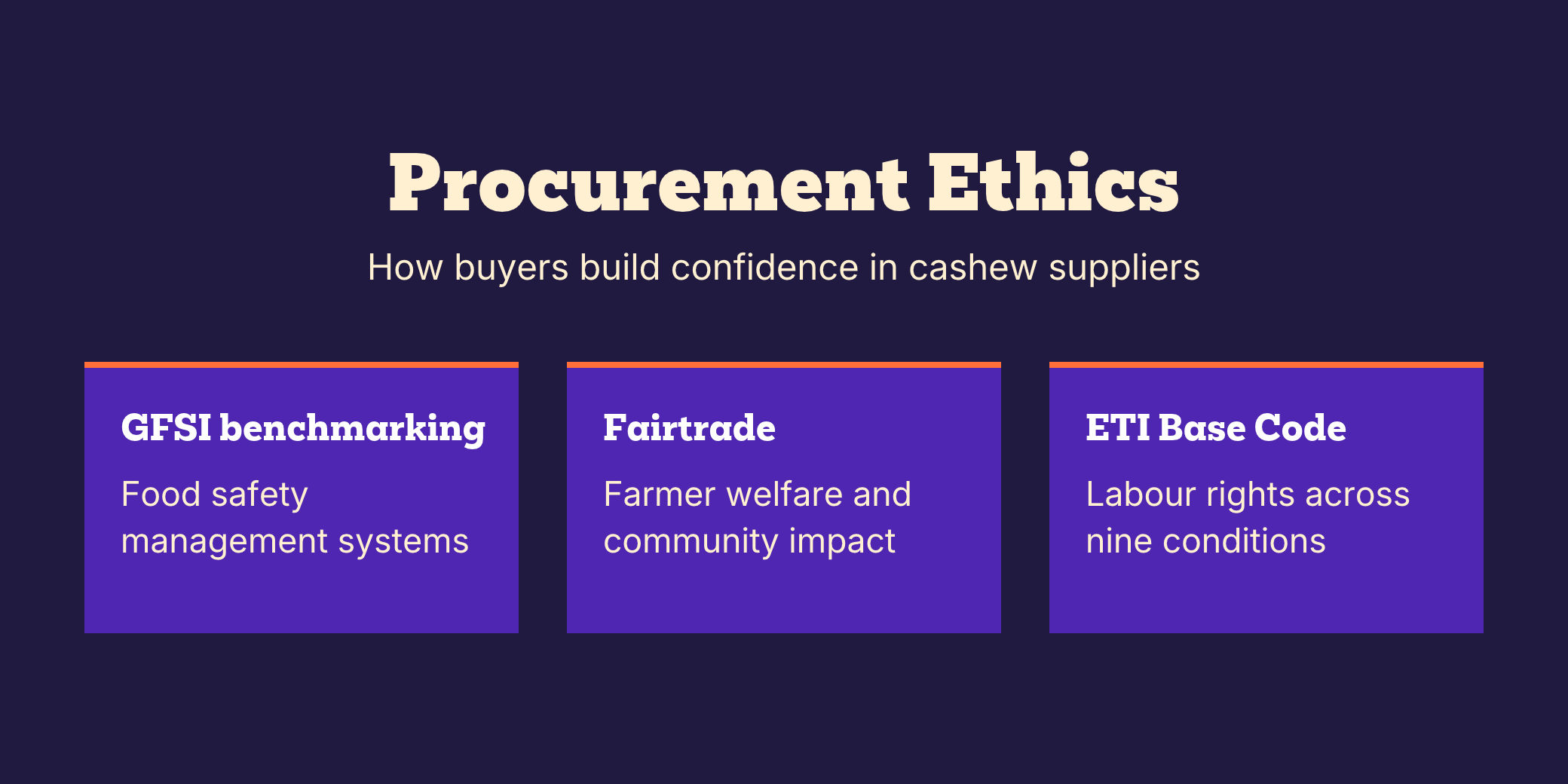
The Global Food Safety Initiative (GFSI) benchmarking framework, covered in detail in module 1.1, creates recognised equivalence between participating food safety certification schemes - BRCGS, FSSC 22000, IFS, SQF and others.
For procurement teams, this means a valid certificate from any GFSI-recognised scheme can, in principle, satisfy the food safety certification requirement without requiring a supplier to hold multiple certificates for different buyers or markets.
This is a genuine practical benefit, and for many large retail and food-service buyers, GFSI-recognised certification has become the expected foundation of supplier qualification. But it's worth being clear about what GFSI benchmarking does not cover, because the gaps are directly relevant to procurement ethics.
GFSI benchmarking assesses food safety management systems. It does not assess labour conditions in processing facilities, farmer welfare at origin, environmental practice, or the accuracy of sustainability claims. A supplier can hold a BRCGS Grade AA certificate and still have significant gaps in the areas that an ethical sourcing policy now typically requires. Buyers who treat GFSI certification as sufficient evidence of a supplier's overall ethical profile are relying on a framework that wasn't designed to provide that assurance.
A food safety certificate is not an ethical sourcing profile. A cashew supplier can hold a BRCGS Grade AA certificate and still have significant gaps in the areas that an ethical sourcing policy now typically requires.
The practical implication for procurement teams is that GFSI certification answers the food safety question. But the labour, environmental and community questions require a separate evidence layer.
Fairtrade Traceability
Fairtrade certification operates on a different logic from food safety certification, and the distinction matters for procurement teams building an ethical sourcing policy.
Food safety certification - BRCGS, FSSC 22000, and their peers - audits a processing or packing facility against a management system standard. The certificate confirms that the facility's documented systems met the standard at the time of audit. However, it says relatively little about the conditions under which the raw material was produced, who produced it, or how value was distributed along the chain.
Fairtrade traceability works differently. The Fairtrade Standards for nuts require that certified products can be traced to a named, audited producer organisation - a cooperative or similar structure - that meets the social, economic and environmental requirements of the standard. This creates a verified link between the product in a buyer's supply chain and the specific community that produced it, including the Fairtrade premium paid to that community and the improvement projects it funded.
For cashew specifically, Fairtrade Standards establish minimum price and premium mechanisms where applicable, alongside requirements on producer organisation governance and social and environmental practices. These requirements address the farmer welfare and community impact dimensions that GFSI benchmarking does not.
For procurement teams, Fairtrade certification provides a different kind of evidence from food safety certification - not evidence that a processing facility met a management system standard, but evidence that the supply relationship itself meets defined social and economic criteria. The two types of certification address different questions and are most valuable used together rather than as alternatives. For instance, Cashew Coast has Fairtrade as well as food safety certifications.
ETI Base Code and Labour-Rights Expectations
The Ethical Trading Initiative (ETI) Base Code is a widely adopted framework for labour rights in supply chains, based on the conventions of the International Labour Organization (ILO). It covers nine conditions:
- Employment is freely chosen
- Freedom of association and the right to collective bargaining are respected
- Working conditions are safe and hygienic
- Child labour is not used
- Living wages are paid
- Working hours are not excessive
- No discrimination is practised
- Regular employment is provided
- No harsh or inhumane treatment is allowed
Many European retailers and brand owners require their suppliers to demonstrate compliance with the ETI Base Code or an equivalent framework, typically through a third-party social audit. The most commonly used audit format is SMETA (Sedex Members Ethical Trade Audit), a widely used social audit methodology that incorporates the ETI Base Code among its reference frameworks.
It's worth being clear about what a facility-level social audit does and doesn't cover in a cashew context: SMETA audits the processing facility, but does not capture farmer income or welfare, labour conditions among seasonal or contract workers at farm level, or the governance structures of the cooperatives supplying raw material. These dimensions, which represent a significant share of the social impact of cashew production, typically sit outside the scope of current social audit requirements and remain one of the most significant gaps in ethical sourcing practice for the sector.
For cashew processors, the ETI Base Code introduces a layer of requirement that sits alongside, rather than within, food safety certification. A processing facility can be fully BRCGS-certified and still have labour practices that wouldn’t meet ETI Base Code requirements - for example, excessive working hours during peak processing season, or restrictions on workers' freedom of association.
For procurement teams, the practical question is whether a social audit requirement is applied at the processing facility level only, or whether it extends upstream to cooperative and farm level. Many current implementations still focus primarily on processing facilities, which means the labour conditions of smallholder farmers and cooperative workers at origin are typically outside the scope of the audit. This is a known gap in current ethical sourcing practice, returned to in the common gaps section below.
| Framework | What it assesses | What it does not cover |
|---|---|---|
| GFSI-recognised certification (for example BRCGS, FSSC 22000, IFS, SQF) | Food safety management systems | Labour conditions in processing facilities, farmer welfare at origin, environmental practice, accuracy of sustainability claims |
| Fairtrade | Traceability to a named, audited producer organisation; minimum price and premium mechanisms; producer governance and social and environmental practices | Whether a processing facility meets a food safety management system standard |
| ETI Base Code, usually checked through a SMETA audit | Labour rights at the processing facility, across nine conditions | Farmer income or welfare, seasonal or contract labour at farm level, cooperative governance |
Source: GFSI; Fairtrade International; Ethical Trading Initiative; Sedex.
Supplier Management Models in Practice
Buyer approaches to supplier management in cashew sourcing tend to cluster into three broad patterns, each with different implications for the quality of the evidence they generate:
1. Annual Certification Model
The most common approach: a supplier is required to hold current, valid certification against defined schemes (typically GFSI-benchmarked for food safety, plus a social audit such as SMETA) and to provide updated certificates at defined intervals.
This model is administratively straightforward and provides a defensible audit trail, but it produces a point-in-time snapshot rather than continuous evidence. A certificate issued eleven months ago tells a procurement team relatively little about current practice.
2. Mixed-Evidence Model
A more developed approach that combines certification with additional evidence layers: laboratory testing results, audit reports including findings and corrective actions rather than just the grade, supplier questionnaires on specific topics such as energy use or labour practices, and periodic buyer-led visits or third-party audits on a risk-assessed basis.
Organic certification, Fairtrade, Rainforest Alliance and equivalent schemes such as Naturland and Bio Suisse can also function as evidence layers within this model; not as substitutes for ethical sourcing assessment, but as independently audited frameworks that provide structured evidence on specific environmental, social or economic dimensions that a food safety audit alone doesn't address.
This model generates richer evidence but requires more procurement resources to manage and is harder to standardise across a large supplier base.
3. Real-Time Data Model
This is an emerging approach, currently more common in higher-value supply chains than commodity cashew. In this model buyers receive continuous or near-continuous data from suppliers' traceability systems - lot-level records, environmental monitoring data, or cooperative-level farmer welfare indicators.
This provides the most current evidence but depends on supplier-side digital infrastructure that’s not yet standard across the cashew sector, as well as on integration between supplier and buyer systems.
Most cashew procurement programmes currently operate in the annual-certification or mixed-evidence space. The direction of travel is towards more documented supply-chain due diligence, driven by regulatory developments such as the Corporate Sustainability Due Diligence Directive.
The Evidence Ladder
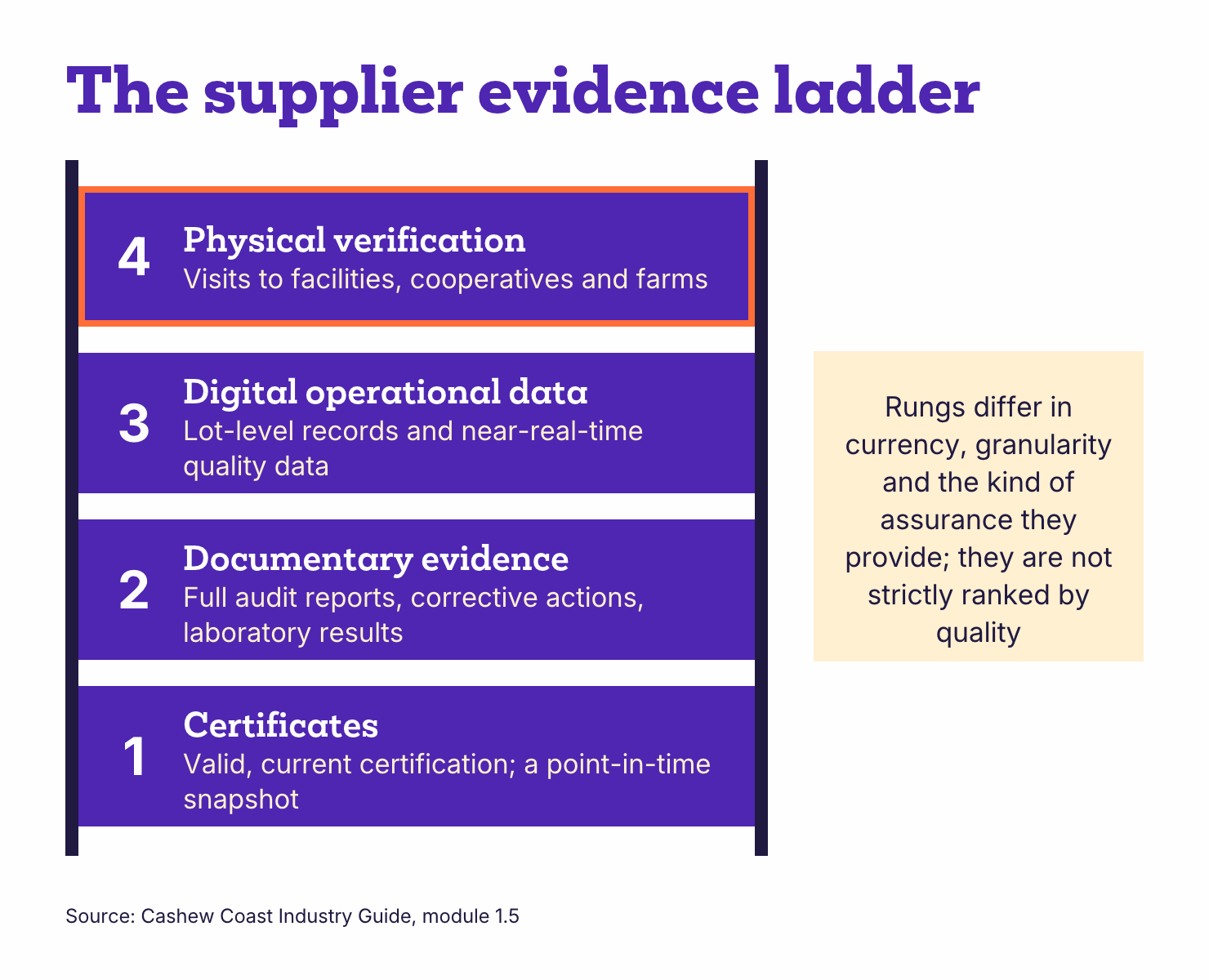
The three supplier management models above can be understood as positions on an evidence ladder, where each rung represents a different type and depth of supplier evidence. The rungs aren't strictly hierarchical in quality - a thorough on-site audit can be more informative than a real-time data feed with poor data discipline - but they differ in currency, granularity and the kind of assurance they provide.
Rung 1: Certificates
Valid, current certification against recognised schemes. Provides evidence that a supplier's documented systems met defined requirements at the time of audit. The foundation of any supplier qualification process, but a point-in-time snapshot rather than ongoing evidence.
Rung 2: Documentary Evidence
The full audit report behind the certificate, including findings, corrective actions and their resolution status, alongside laboratory testing results, organic or Fairtrade certification documentation, and supplier questionnaire responses. Materially more informative than the certificate grade alone - a supplier with a B grade and a strong corrective action record may represent lower risk than one with an A grade and recurring findings in the same clause area, as covered in module 1.1.
Rung 3: Digital Operational Data
Lot-level traceability records, real-time or near-real-time quality data, and where available, origin-side data on farmer registration, cooperative governance or environmental monitoring. This rung provides the most current evidence and the fastest response capability in an incident scenario, as documented in module 1.4. Its value depends entirely on the quality and completeness of the underlying data: digital systems with poor data discipline provide weaker evidence than a well-documented paper audit trail.
Rung 4: Physical Verification
Buyer-led or independent third-party visits to processing facilities and, in more developed programmes, to cooperatives and farms at origin. Provides direct observation of conditions that documentation and digital data cannot fully capture, and is the most resource-intensive form of evidence. On-site verification is also the only rung that can meaningfully assess the dimensions a SMETA audit doesn't reach: farmer welfare, cooperative governance and seasonal labour conditions at origin.
Many leading buyers are increasingly combining these evidence layers, not by replacing lower rungs but by adding higher ones for strategic supplier relationships and higher-risk categories. The metrics module 1.6 covers how buyers are beginning to formalise the indicators used at each rung into measurable supplier performance frameworks.
Building and Stress-Testing a Procurement Ethics Policy
For a procurement lead refreshing an ethical sourcing policy for cashew, a practical checklist might include the following.
Define the Scope Explicitly
Which elements of the supply chain does the policy cover - processing facility only, or cooperative and farm level? Which topics does it address - food safety only, or labour, environment and community impact as well? Gaps in scope are gaps in assurance, and they tend to be exploited under audit pressure.
Map Current Supplier Evidence Against the Evidence Ladder
For each strategic cashew supplier, identify which rung of the ladder current evidence sits at, and whether that's appropriate for the risk profile and commercial importance of the relationship.
Check Certification Scope, Not Just Certificate Status
A valid certificate is not sufficient evidence on its own - the scope needs to cover the specific products, processes and sites relevant to the supply relationship. This is covered in module 1.1.
Require Audit Reports, Not Just Grades
A certificate grade tells you the outcome of an audit; the report tells you what was found, what was required to be corrected, and whether it was. The latter is significantly more informative for ongoing risk management.
Extend the Labour Question Upstream
If current social audit requirements stop at the processing facility, consider what evidence exists on cooperative governance, farmer welfare and labour conditions at origin. This is a known gap in most current programmes and an area of increasing regulatory attention.
Test the Incident Response
Ask suppliers how they would respond to a specific scenario - a contamination finding, a regulatory inquiry, a media question about labour conditions at a named cooperative. The quality of the answer reveals more about operational maturity than a certificate grade.
Review Against Current and Upcoming Regulation
The Corporate Sustainability Due Diligence Directive, the EU Deforestation Regulation, and FSMA Section 204 all have implications for the evidence a procurement team needs to hold. A policy that meets current requirements may not meet requirements that come into force within the next two years.
Common Gaps in Current Approaches
The most frequently occurring weaknesses in cashew procurement ethics policies follow a recognisable pattern:
Over-Reliance On Certificates
Treating a valid certificate as sufficient ongoing evidence, without access to audit reports, corrective action records, or more current data. This is the most common gap and the one most likely to produce surprises when an incident occurs or a regulatory inquiry arrives.
Weak Farmer-Level Verification
Most current ethical sourcing frameworks for cashew have robust requirements at the processing and export level but limited visibility at farm and cooperative level. Given that a significant share of the social and environmental impact of cashew production occurs at origin, this is a significant gap.
Misaligned Audit Scopes
A social audit commissioned for one purpose - demonstrating labour compliance to a retail customer, for example - may not cover the topics relevant to a different buyer's code of conduct, or may not extend to the sites most relevant to that relationship. Procurement teams that accept third-party audit reports without checking scope alignment may be relying on evidence that doesn't address their actual requirements.
Certificate-Led Supplier Selection
Selecting suppliers on the basis of certification status rather than the quality of the underlying systems and evidence. A supplier who can demonstrate lot-level trace-back on request, provide full audit reports with corrective action records, and respond credibly to a scenario question represents lower procurement risk than one with equivalent certificate grades but weaker underlying capability, regardless of which was selected first.
For a broader view of how supplier evidence translates into measurable performance indicators, continue to module 1.6, Metrics for Trust. For the sustainability and environmental dimensions of ethical sourcing in cashew, Part 2, Sustainability and Regenerative Practices, examines the evidence base for environmental claims and certification in more detail.
For enquiries about procurement collaboration, ethical sourcing pilots, or expert comment, please get in touch.
Evidence and methodology: you can learn about our source vetting standards, data attribution policy, editorial independence and amendment policy here.