
What a Traceability Protocol Actually Is
Module 1.1 examined the standards that define what a compliant cashew supply chain should achieve: certification schemes such as BRCGS, design frameworks such as ISO 22005, and the regulatory baseline set by Codex Alimentarius and EU law.
A protocol is a different layer. Where a standard describes the outcome a system should deliver, a protocol describes how information actually moves between the parties handling a cashew lot.
Traceability standard or traceability protocol? A traceability standard describes the outcome a system should deliver. A traceability protocol describes how information actually moves between the parties handling a cashew lot.
In practical terms, a traceability protocol answers three questions for any given shipment:
- How is this lot identified, consistently, by everyone who touches it?
- What information is recorded at each point it changes hands?
- Who is responsible for keeping that record intact and retrievable?
A processor can hold a valid food safety certificate and still have a traceability protocol that breaks down in practice - for example if lot identifiers change format between the farm gate and the processing facility, or if the data captured at one handover point doesn’t match what the next party in the chain expects to receive. This module sets out the frameworks that address that gap and the practical decisions that determine whether a protocol functions on the ground.
UNCTAD Framework: A Conceptual Starting Point
The United Nations Conference on Trade and Development (UNCTAD) has developed guidance on traceability and transparency for sustainable agricultural value chains through its BioTrade programme. While not a formal international standard equivalent to Codex or ISO, it provides a useful conceptual framework for thinking through what multi-stakeholder traceability systems need to achieve across supply chains involving multiple countries and multiple types of organisation.
Three conditions recur across UNCTAD's guidance and are widely treated as minimum requirements for a workable traceability protocol in agricultural commodities:
1. Consistent Identifiers
Every lot needs an identifier that means the same thing to every party in the chain. If a cooperative assigns one numbering system and an exporter assigns another without clear mapping between the two, the chain of custody breaks at that handover, even if both parties keep accurate records on their own side.
2. Minimum Data Fields at Each Handover
Each point where a lot changes hands or form (raw nuts becoming processed kernels, for instance) needs an agreed minimum set of information to travel with it. What that minimum should include depends on the buyer and the market, but it commonly covers origin, date, quantity, and any quality or condition data relevant to the next stage of handling.
3. Assigned Responsibility for the Audit Trail
Someone in the chain needs to own the record of what happened to a lot, and needs to be able to produce it on request. Without a named responsibility, audit trails tend to exist in fragments across multiple parties' systems, which makes reconstruction slow and incomplete when it matters most, such as during a recall or a buyer audit.
UNCTAD's framework is generic to agricultural supply chains rather than specific to cashew, which is why sector-specific guidance, covered in the following two sections, plays an important role in translating these principles into practice.
CBI Cashew Traceability Guidance for European Markets
The Centre for the Promotion of Imports from developing countries (CBI) publishes market entry guidance for exporters targeting the European Union, including cashew-specific traceability expectations. This guidance is aimed squarely at exporters and sets out what European buyers, certification bodies and regulators are likely to expect in practice, rather than describing traceability in the abstract.
CBI's guidance addresses documentation requirements that sit alongside the food safety certification covered in module 1.1, including phytosanitary documentation for in-shell nuts, lot identification that can be cross-referenced against shipping and customs records, and the labelling requirements that allow a retail product to be traced back to its country of origin under applicable EU food information and customs requirements.
For exporters preparing to enter European markets for the first time, this guidance acts as a practical checklist of the documentation that needs to exist before a shipment can move, rather than a theoretical traceability framework. It’s most useful when read alongside module 1.1, since certification and documentation requirements are closely linked in practice, and a gap in one often surfaces as a problem in the other during a buyer audit.
Sustainable Nut Initiative: A Sector-Led Protocol
The Sustainable Nut Initiative (SNI) brings together companies and organisations working across the nut sector, with the aim of improving conditions in producing countries and supporting more sustainable supply chains. Its membership spans importers, processors and other supply chain participants with an interest in shared standards for sourcing and traceability.
What SNI adds, relative to the generic frameworks from UNCTAD and the market-access guidance from CBI, is a layer of protocol that’s been worked out specifically for nuts as a category, including cashew. This matters because nut supply chains have characteristics that differ from other agricultural commodities. The shift from in-shell raw material to processed kernel, for example, often happens in a different country from where the crop is grown, which creates a handover point that generic agri-food frameworks don’t always address in detail.
Membership of SNI is one way for a processor or exporter to align with a sector-specific protocol, rather than building traceability documentation from first principles against generic standards alone. For buyers, supplier participation in SNI can be one indicator, among several, of an exporter's engagement with sector-wide traceability practice, though it’s not a substitute for verifying a specific supplier's own systems and documentation.
The 4 Building Blocks in Practice
Returning to the three conditions from UNCTAD's framework, each one has a practical cashew-specific form worth setting out clearly. A fourth — lot splitting — is not explicitly addressed in the UNCTAD framework but is among the most significant technical challenges in cashew traceability specifically.
1. Lot Identifiers
In a cashew supply chain, a lot identifier typically needs to survive several transformations: raw cashew nuts harvested from a defined area or set of farms, aggregated by a cooperative or buying agent, processed into kernels at a factory, and packed for export. A workable identifier scheme either carries through all of these stages unchanged, or maintains a documented mapping between the identifier used at each stage and the one used before it. GS1 standards, widely used across food and retail supply chains, provide a common structure for this kind of identifier and are increasingly referenced in cashew sector guidance for exactly this reason.
2. Handover Data Fields
At each point a lot changes hands, the data that travels with it needs to match what the receiving party requires to do their part of the job, and to satisfy their own buyers or regulators downstream.
For a processor receiving raw cashew nuts, this typically includes origin, harvest season or buying campaign (exact harvest dates are rarely available and most systems record the collection period rather than a specific date), moisture content, KOR (Kernel Outturn Ratio - the principal commercial quality parameter for RCN, expressing the weight of kernels extractable from a given weight of in-shell nuts), and any pre-processing quality assessment results.
For an exporter preparing a shipment, it typically includes processing date, production line, shift and operator details where these are captured, grade according to applicable commercial specifications such as AFI or Casamance grading standards, certification status, and the documentation needed to clear customs and meet the importing country's phytosanitary requirements.
| Handover point | Data that typically travels with the lot |
|---|---|
| Processor receiving raw cashew nuts | Origin; harvest season or buying campaign; moisture content; KOR (Kernel Outturn Ratio); pre-processing quality assessment results |
| Exporter preparing a shipment | Processing date; production line, shift and operator details where captured; grade (for example AFI or Casamance grading standards); certification status; customs and phytosanitary documentation |
Source: Cashew Coast Industry Guide, module 1.2.
3. Audit-Trail Responsibility
In practice, this usually falls to whichever party has the most complete view of the chain at a given point, often the processor or exporter rather than individual farmers or small cooperatives, who may lack the systems or capacity to maintain comprehensive records of their own.
This makes it important for processors and exporters to actively manage the records they receive from upstream, rather than treating supplier-provided data as already verified and complete.
4. Lot Splitting
One of the most significant technical challenges in cashew traceability is lot splitting, and it's arguably harder to manage than aggregation. A single incoming RCN lot entering the processing facility generates multiple distinct output streams: WW320, WW240, LP, SP, baby bits, shells, testa and CNSL feedstock. Each output stream needs its own lot identifier while remaining linked back to the parent RCN lot, so that a question about any output - such as ‘which cooperative contributed to this bag of WW240?’ - can be traced back through the split.
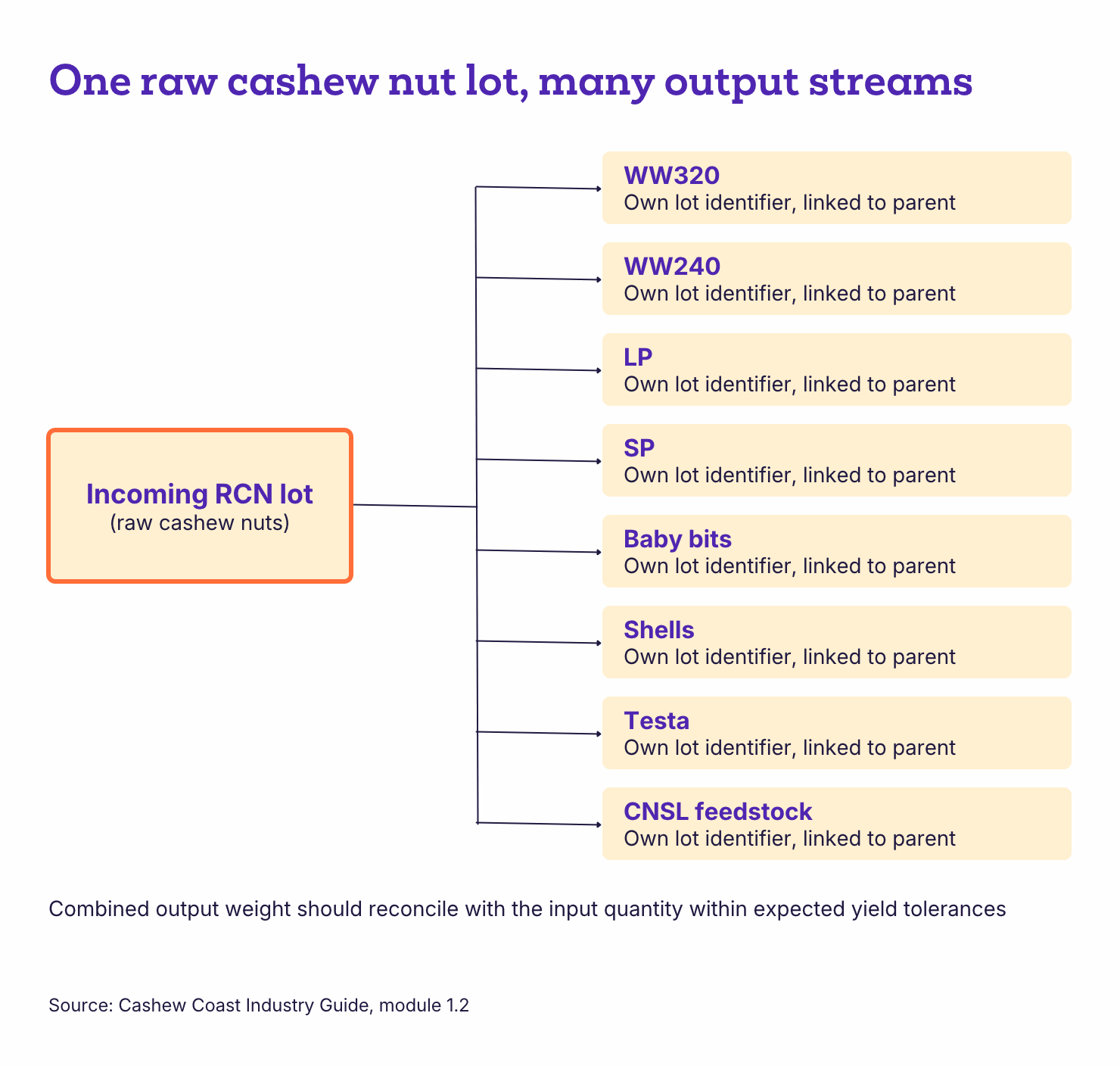
This one-to-many relationship also requires yield accounting at each output stream: the combined weight of all outputs from a given RCN lot should reconcile against the input quantity within expected yield tolerances, providing both a data integrity check and the mass-balance foundation described in module 1.6. Without explicit lot splitting records, the parent-child relationship established at goods receiving is lost the moment processing begins, and genuine farm-to-product traceability becomes impossible to reconstruct after the fact.
Where the Data Moves: Farmer to Buyer
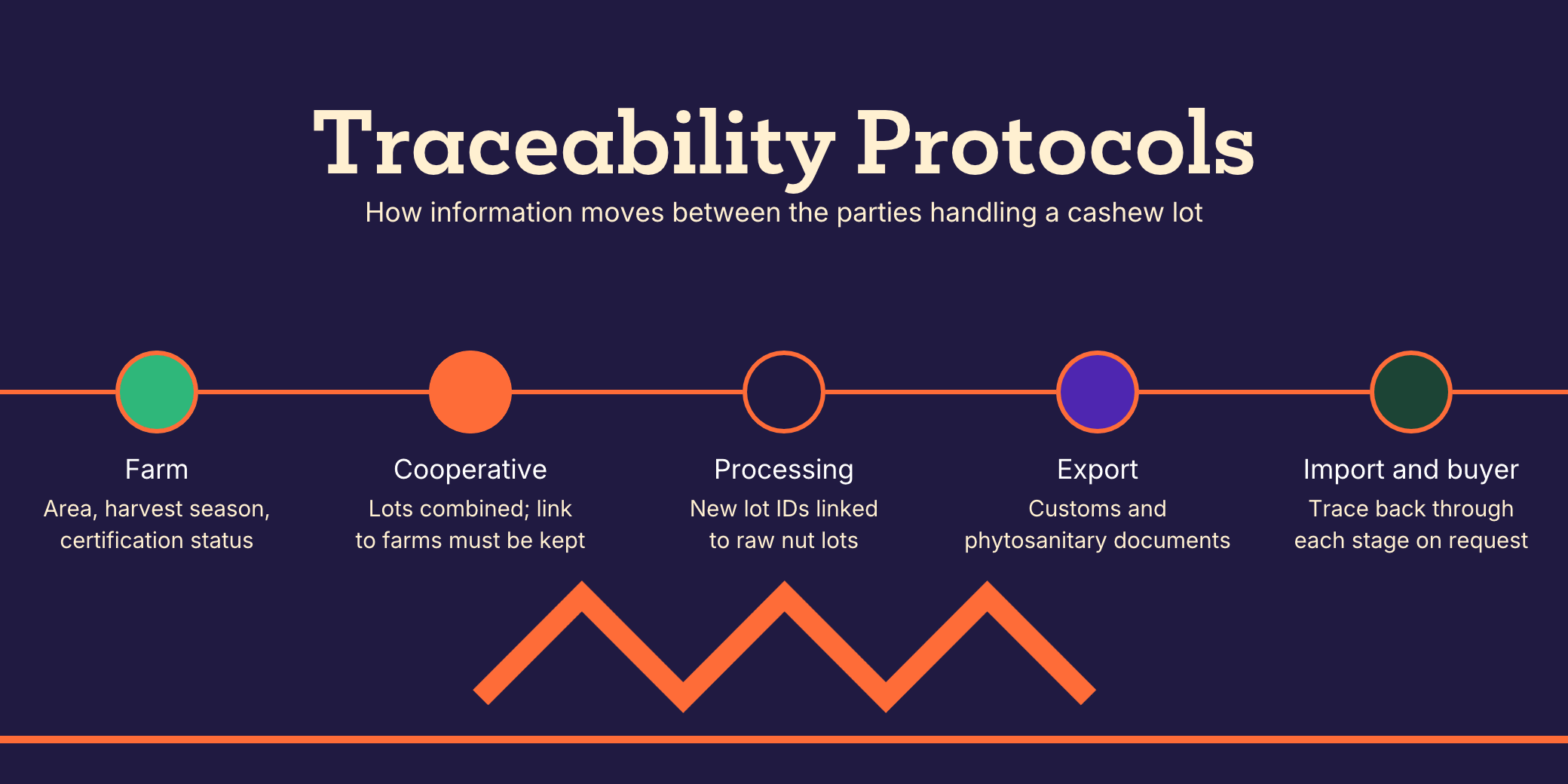
A simplified view of the cashew supply chain helps illustrate where traceability data is generated, recorded, and handed over.
Farm Level
Here the relevant data is typically limited to the area or farms the crop came from, the harvest date or season, and in some cases organic or certification status if the farmer is part of a certified scheme.
Smallholder farmers, who account for a large share of cashew production in West Africa, for instance, often don’t maintain digital records at this stage, which has implications addressed in the final section of this page.
Cooperative or Aggregation Level
Raw cashew nuts from multiple farms are typically combined, and this is where the first significant traceability challenge tends to appear: maintaining a link between the aggregated lot and the individual farms or growers that contributed to it, rather than collapsing that information into a single undifferentiated batch.
Processing Level
Processing often introduces new production lot identifiers while maintaining documented links to the incoming raw material lots.. Data added here typically includes processing date, kernel outturn/yield, grade distribution, and quality testing results relevant to food safety certification.
Export Level
Here kernels are packed, certified and documented for shipment, with data fields expanding to include customs documentation, phytosanitary certificates where required, and the export-level certification status referenced in module 1.1.
Import and Buyer Level
The receiving party typically expects to be able to trace the shipment back through each of these stages on request, which is only possible if the data captured at each prior stage has been retained and made accessible.
Common Implementation Challenges
Several recurring challenges affect cashew traceability protocols in practice, regardless of which framework or standard a processor is working towards.
Inconsistent Farmer-Level Data
Where farmers don’t maintain their own records, the cooperative or aggregator becomes the first point at which traceability data is actually created, rather than simply collected. This means the accuracy of farm-level data often depends heavily on the practices of the aggregating organisation, which can vary considerably between regions and cooperatives.
Aggregation Gaps
When raw cashew nuts from many small farms are combined into a single lot, there’s a practical tension between traceability granularity and operational efficiency. Tracing a lot back to an individual farm becomes harder, and sometimes impossible, once aggregation has occurred, unless the cooperative has specifically designed its process to preserve that link.
Cross-Border Data Format Mismatches
Where a cashew supply chain crosses borders - which is the norm rather than the exception in this industry - data formats and identifier schemes used in the country of origin don't always map cleanly onto those expected by the importing country or buyer.
Practical sources of mismatch include different ERP systems at either end of the chain that use incompatible lot identifier formats, documentation in different languages requiring translation that introduces transcription risk, and unit conversions between the weight and volume measures used at origin and those required by the importing market.
These gaps tend to appear at exactly the point where regulatory scrutiny is highest, making cross-border format alignment worth addressing in protocol design, rather than leaving it to be resolved shipment by shipment.
From Paper to Digital: What Changes and What Stays the Same
Many cashew exporters still rely on paper records or a hybrid of paper and basic digital tools such as spreadsheets, particularly at the farm and cooperative level. This introduces practical risks: transcription errors when data is copied between systems or re-entered at each handover, and slower response times when a buyer or regulator requests trace-back information during an incident, since paper records typically need to be physically located and manually cross-referenced.
The case for digitisation goes beyond retrieval speed. Digital systems also provide version control — maintaining a record of when entries were made and whether they were subsequently amended — user accountability through individual login credentials that attribute each data entry to a named person, automatic timestamps that record the precise time of each transaction rather than relying on manual date entries, and validation rules that can flag implausible data at the point of entry rather than during an audit weeks later. These features don't prevent data errors, but they make errors visible and attributable in ways that paper records rarely allow.
The transition from paper to digital traceability systems is rarely a single, complete switch. Phased adoption, where digital systems are introduced at the points in the chain best equipped to use them, tends to be more common in practice than a full system rollout implemented all at once. A processor might digitise records at the factory and export stages first, where infrastructure and staff capacity are usually most developed, while farm and cooperative-level data continues to be captured on paper and entered into the digital system at the aggregation point.
This pattern is common in practice, though not universal. Cashew Coast followed a different sequence: digitising the supply side first, while the supply chain was still small enough to make the transition manageable, on the basis that retrofitting digital systems to a larger, more complex supply chain later would be significantly harder. Factory and export stage digitisation followed. The broader lesson holds regardless of sequence: the underlying protocol — consistent identifiers, agreed data fields, clear audit-trail responsibility — needs to be in place before the technology is deployed, not defined around it
A practical driver of digital traceability investment that sits outside the certification framework is the EU Deforestation Regulation. Although cashew is not currently within EUDR scope, many buyers are harmonising their traceability systems across multiple commodities simultaneously and that process is generating requests for geolocation data and enhanced lot-level documentation from cashew suppliers, even where no legal obligation yet exists. For cashew processors whose buyers also source cocoa, coffee or other EUDR-covered commodities, the practical pressure to adopt digital systems capable of capturing GPS coordinates and plot-level origin data is arriving ahead of any regulatory requirement.
What stays constant through this transition is the underlying protocol: consistent identifiers, agreed data fields at each handover, and clear responsibility for the audit trail. Digitisation can make these easier to maintain and faster to retrieve, but it doesn’t substitute for getting the protocol itself right. A digital system built on inconsistent lot identifiers or unclear handover responsibilities will simply digitise the same gaps that existed on paper.
The specific technology choices involved in this transition, including blockchain-based platforms, QR codes, and RFID tagging, are addressed in detail in module 1.3.
For enquiries about contributing traceability or food safety standards data or case studies, or to request expert comment, please get in touch.
Evidence and methodology: you can learn about our source vetting standards, data attribution policy, editorial independence and amendment policy here.